
AI for supplement & wellness ecommerce: routines, reorders and the add-on that keeps winning
In supplements, the sale is a routine completed today and restocked later. What to recommend at each moment and what to measure, with the real Fungi Melena case.

In supplement and wellness ecommerce, the sale doesn't end with the order: it plays out over time. People don't buy a bottle, they build a routine, and that routine gets completed today and restocked a few weeks from now. So recommendations have two jobs: add the product that completes the routine to today's order, and set up the next purchase before the bottle runs out.
This guide covers which product relationships sell in supplements, what to recommend at each moment of the purchase, the mistakes to avoid and what to measure, with real data from a store that uses CrossUp: Fungi Melena. One note before we start: this is about how people buy, not about what each product does. Health promises have no place in a recommendation.
Which relationships sell in supplements and wellness
In this category, the recommendations that work follow the logic of a routine, not of a store shelf:
- The routine complement. Another product the shopper adds to what they already take, at a different time of day or for a different goal. It's the relationship that pays off most, as the data below shows.
- The format. The same product in capsules or as an extract, in a small or a large pack. The recommendation doesn't add a new product: it helps pick the format that works best for that person.
- The bundle. Two or three products packed as a routine, at a price that's clearly better. It simplifies the decision for someone just starting out.
- The reorder. When the pack runs out, buying again has to be effortless. This is the relationship that keeps the business going.
- The accessory. What goes with the habit: the pill organizer, the cup, the snack from the same brand. Small decisions that add up without competing.
What doesn't work is recommending by similarity: two products with the same active ingredient in different packs cancel each other out, and the shopper ends up picking one.
The Fungi Melena case: one add-on that wins everywhere
Fungi Melena sells mushroom supplements and has used CrossUp since 2023. The figures below cover the last 90 days to Oct 24, 2026 and are observational: they show what happened with the recommendations, with no control group, so they don't say how much would have sold without them.
- 11.4% of orders included at least one recommended product (n = 12,006 orders).
- The lift in the ticket of orders with a recommendation (the recommended item over the rest of that order) was 49% (n = 1,337 orders with a recommendation and something else in the cart).
- Of the recommendations shoppers added to the cart, 31.5% ended up in a paid order (n = 3,700 added).
The most interesting part is in the combinations. These are three of the store's best at add to cart (among the best, not the average):
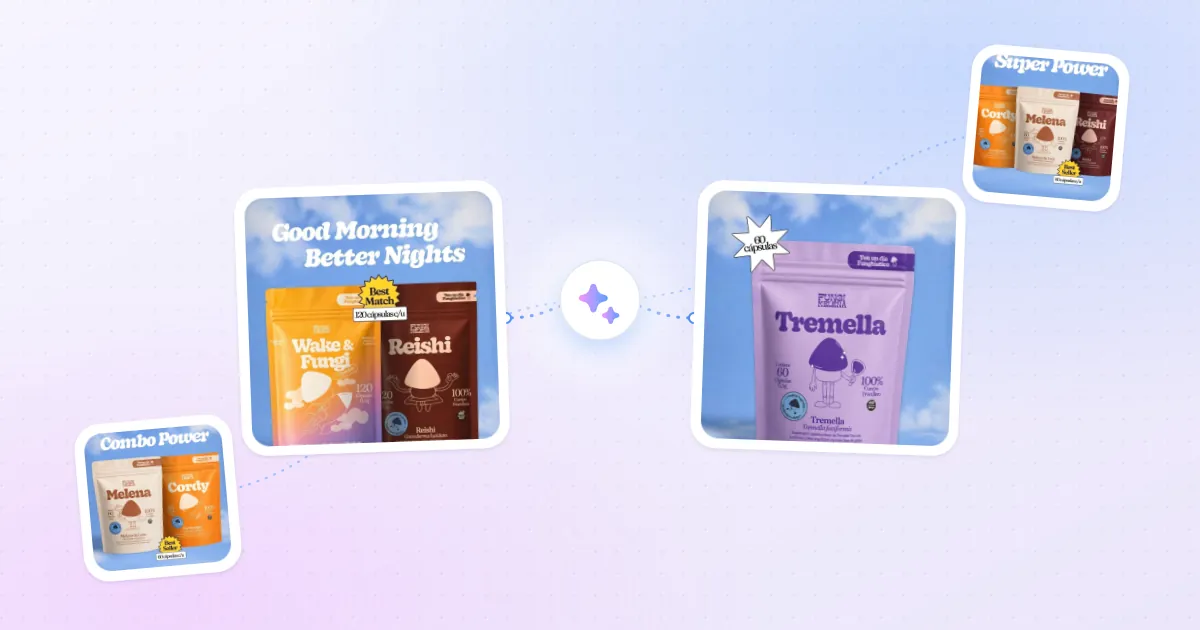
- Combo Good Morning + Better Nights → Tremella en Cápsulas. Shown 456 times: 14.0% added it and 6.4% bought it.
- Combo SuperPower (Melena de León, Cordyceps y Reishi) → Tremella en Cápsulas. Shown 1,214 times: 15.1% added it, 5.4% bought it.
- Combo Power (Melena de León y Cordyceps) → Tremella en Cápsulas. Shown 2,099 times: 12.0% added it, 4.4% bought it.
And the pattern goes beyond those three: of all the combinations shown at least 60 times and bought at least 4 times, the 14 with the best purchase rate all end in Tremella. Whoever picks a ready-made bundle adds a single product that completes their routine. It's a pattern that shows up in the data, not a guess. The full case, with photos of each combination, is in Fungi Melena.
The lesson applies to any store in the category: wellness catalogs tend to have a "bridge" product, the one many people add to whatever they already chose. Finding it by hand is hard; seeing it in the data isn't.
What to recommend at each moment of the purchase
Product page
The shopper is still reading up. This is the place for format and bundle: the same product in the pack that lasts longer, or the routine that includes it. It's also where you can show clearly which products people usually take together, without promising results.
Add to cart
The moment of highest intent. This is where the routine complement pays off, and where Fungi Melena's best combinations showed up. One clear recommendation, few options, added without leaving the page.
In the cart
While reviewing the order, shoppers are willing to complete it. Accessories and small formats work well: things that add without changing the main decision.
At checkout
They're paying. Only something small and obvious, an instant decision, belongs here. Fungi Melena uses this moment as well as add to cart and the cart.
Thank-you page
This is the moment for the reorder. Today's purchase is done; what matters now is setting up the next one: the same product for when it runs out, or the routine step they still don't have. In a category that lives on repeat purchases, this moment is worth more than it looks. We covered how to use each one in the 5 conversion moments.
Common mistakes in supplement stores
- Promising results in the recommendation. The recommendation says "often bought with" or "completes your routine", not what it will achieve. Product information belongs on the product page.
- Recommending two products that overlap. The same active ingredient in two formats doesn't add up: it forces a choice.
- Ignoring format and size. Offering the small pack to someone who already buys the large one makes no sense, and vice versa.
- Bundles that are always discounted. If the bundle is always on sale, people learn to buy only on sale. The incentive has to be clear and sustainable.
- Showing out-of-stock products. In routines, running out of a product breaks the habit; recommending it when it's gone does too.
- Forgetting the thank-you page. It's the natural place for the reorder, and many stores don't use it.
What to measure, in percentages
Always with the period and the sample size in view:
- % of orders with a recommended product. At Fungi Melena, 11.4% in the last 90 days to Oct 24, 2026 (n = 12,006).
- Lift in the ticket of orders with a recommendation (the recommended item over the rest of that order). 49% at Fungi Melena (n = 1,337). Don't confuse it with comparing the ticket of orders with and without recommendations: that comparison mixes causes.
- The funnel: shown → added → bought. Of 43,874 recommendations shown at add to cart and at checkout, 8.4% were added and 2.7% were bought.
- % of added items that get bought. 31.5% at Fungi Melena. If it's low in your store, check price, stock and the moment the recommendation appears.
- Attributed revenue as a share of total revenue. A percentage, never an amount: at Fungi Melena, attributed revenue from recommendations was 4.9% of everything the store sold in the period, across all moments.
Another store's figures are a reference, not a target: every catalog and every audience is different.
How to get started
- Organize your catalog by routine and format. Clear names help tell a complement from a format and a bundle.
- Turn on "add to cart" first, where intent is highest.
- Add the thank-you page for reorders, and the cart and checkout for accessories and small formats.
- Build a few bundles, and make them recognizable routines.
- Find your bridge product. Every few weeks, check which combinations have the best purchase rate, with their sample size.
CrossUp does this with SalesPilot, its AI engine: it decides with your catalog, your stock, your orders, the product being viewed and what's already in the cart, recommends across the 5 purchase moments and attributes every recommended product to the order that bought it. You can try it free for 15 days. See how it works for your category in AI for supplement and wellness stores, or read the Fungi Melena case.