
AI for home and decor stores: how to sell the whole room, not the single piece
What to recommend in a home and decor store at each moment of the purchase, sets versus single pieces, and what to measure in %. With real data from Ganga Home and Hudson Cocina.

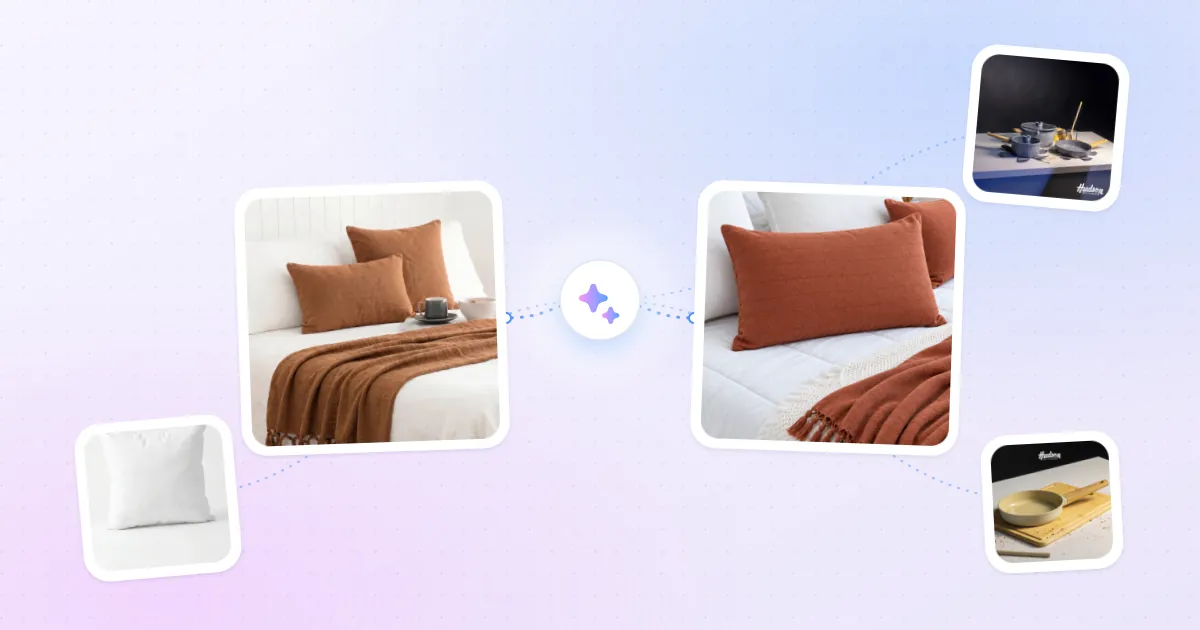
Nobody buys a throw thinking about the throw. They're thinking about the sofa, the color of the walls, how the living room will look. In a home and decor store the real sale is the room, but an online store shows single pieces: a throw, a cushion cover, a side table. AI for home and decor stores closes that gap: when someone chooses a piece, it shows them the one that completes it, from the same line and in stock.
In this guide we cover which relationships sell in home goods, what to recommend at each of the 5 moments of the purchase, the mistakes that cost the most and what to measure. With real numbers from two stores that use CrossUp: Ganga Home, a home and decor store, and Hudson Cocina, a kitchenware store.
Should you sell sets or single pieces?
Both, at different moments. A ready-made set (bedspread with shams, a full cookware set) simplifies the decision for someone who wants to solve everything at once. A single piece with its complement right next to it respects the shopper who already has half the room and is only looking for one part. Bundled packages and individual items aren't rivals: the AI recommends the missing piece based on what the shopper already chose, and discounted bundles are for when the set makes sense as a package.
The relationships that sell in home and decor
- Same line and color. The throw and the cushion cover from the same collection, the same terracotta shade. It's the strongest relationship in decor: the shopper has already chosen a look.
- What the piece needs to be used. The cushion cover needs its insert, the crêpe pan needs a spatula. It's the functional complement, the one you notice is missing when the box arrives.
- The pair from the same series. The water bowl with the food bowl, the pot with its frying pan. Pieces bought separately but thought of together.
- Size variant. Twin, queen or king; 45x45 or 50x70. On the product page, showing the right size prevents returns.
What to recommend at each moment
On the product page: size and line
Before adding to cart, the shopper is deciding. This is the place to show other sizes and colors from the same line, and the pieces that go with it. It works especially well in kitchenware: someone looking at a cookware set wants to see what else that line has.
When adding to cart: the piece that completes it
This is the strongest moment in home goods. The shopper has just confirmed the throw: the natural recommendation is the cushion cover from the same line. They've just added cushion covers: the insert in that size. This is where the best numbers show up.
In the cart: what adds to the room
A carousel in the cart with small pieces that round out the room (candles, placemats, a decorative book) helps reach free shipping without interrupting the purchase.
At checkout: something simple
At checkout, only what needs no thinking: a replacement part, a low-priced accessory. Nothing that makes the shopper measure the sofa again.
On the thank-you page: the next room
After the purchase, recommend what completes the room they just started, or the line they chose in another color.
Ganga Home: the room, piece by piece
Ganga Home is a home and decor store that has used CrossUp since 2023. It recommends mostly when adding to cart and with a carousel in the cart. Over the last 90 days to Oct 24, 2026:
- 11.8% of orders included a recommended product (n = 80,100 orders).
- The order value lift on orders with a recommendation (the recommended item over the rest of that order) was 20.1% (n = 9,460 orders).
- Of the recommendations shown when adding to cart and at checkout (n = 1,149,354), 4.8% were added to the cart and 0.86% ended up purchased; of those added, 17.8% were bought.
- Attributed revenue from recommendations was 2.9% of everything the store sold in that period.
Some of its best combinations (of those shown at least 60 times and bought at least 4 times; not the average):
- Cusco Terracota throw 150x200 → Cusco Terracota cushion cover: shown 788 times; 35.3% added it and 9.0% bought it.
- Pet water bowl → pet food bowl: shown 169 times; 30.2% added it and 9.5% bought it.
- Set of 2 Dakota 45x45 cushion covers → 45x45 insert: shown 102 times; 26.5% added it and 5.9% bought it.
All three follow the same logic: same line and color, the pair from the same series, and what the piece needs to be used. The full case study is at Ganga Home.
Hudson Cocina: the whole line in the kitchen
Hudson Cocina sells kitchenware and has used CrossUp since 2025 at almost every moment: when adding to cart, bundles, checkout, product page and carousel. Over the last 90 days to Oct 24, 2026:
- 17.6% of orders included a recommended product (n = 3,260 orders).
- The order value lift on orders with a recommendation (the recommended item over the rest of that order) was 34.4% (n = 547 orders).
- Of the recommendations shown when adding to cart and at checkout (n = 25,414), 8.2% were added and 1.5% ended up purchased; of those added, 18.4% were bought.
Some of its best combinations:
- STONE cookware set → STONE 14 cm saucepan, on the product page: of 113 clicks on the recommendation, 16.8% ended in a purchase. Note: the base here is clicks, not times shown, so it isn't comparable with the cart.
- STONE 22 cm crêpe pan → slotted spatula with wooden handle, when adding to cart: shown 81 times; 12.3% added it and 4.9% bought it.
- Harmony 20 cm pot → Harmony 24 cm frying pan, when adding to cart: shown 103 times; 7.8% added it and 4.9% bought it.
In the kitchen the value of the line is clear: whoever picks STONE or Harmony wants the rest of that line, and the utensil that goes with it. The full case study is at Hudson Cocina.
An honest note for both cases: this is observational data. It shows what happened with the recommendations, not how much would have sold without them, because there is no control group.
Common mistakes in home goods stores
- Recommending the wrong size. A 50x70 cover for a 45x45 insert is a guaranteed return. Sizes have to match.
- Mixing colors that clash. In decor, a recommendation that breaks the palette undermines trust in the whole store.
- Offering what's already in the cart. It happens more than you'd think with pieces sold in several sizes.
- Putting expensive items at checkout. Nobody decides on a sofa while paying. At checkout, keep it small.
- Bundles with no room logic. A bundle that mixes pieces from different lines doesn't make sense. If you want discounted sets, read bundles that work.
What to measure, in percentages
- Share of orders with a recommended product. How many orders include at least one piece that came from a recommendation.
- Added and bought over shown. What share of recommendations gets added to the cart and what share ends up purchased.
- Share of added recommendations that get bought. If they're added but not bought, check shipping, sizes or stock.
- Order value lift on orders with a recommendation (the recommended item over the rest of that order). How much the recommended piece adds against what the shopper was already buying.
Always with the period and the number of cases next to them. And avoid comparing the order value of orders with and without a recommendation: that's correlation, not effect.
How to get started
- Organize the catalog by line, color and size. It's what makes it possible to recommend the right piece.
- Turn on the add-to-cart moment. That's where the completing piece performs best.
- Add the product page if you sell by line. In kitchenware and bedding, showing the whole line helps people decide.
- Measure for a few weeks and adjust. See which combinations get added and which get bought.
With CrossUp, SalesPilot (its AI engine) builds your store's product map (what goes with what, what's a variant, what sells together) and decides what to show at each moment. You can add manual rules, and the trial is 15 days free.
To see how it applies to your category, visit AI for home and decor stores. And to understand where each recommendation appears, read the 5 conversion moments of an e-commerce store.